|
During this May/June school holidays, do you wish that your kids can enhance their creativity by attending creative lessons which will help them achieve better results in their school work and be useful for their future? NeuroFlash's Creative Cultivation Laboratory has planned a full programme of creative workshops, learning courses and special programmes for your children. Please click here to download the schedule we have planned for your kids..
******

NeuroFlash Private Limited's own product, the Fuel Cell Exploratory Kit is available now. For more information please click on the ANNOUNCEMENT link. If you wish to purchase a set, please go to the shopping cart by clicking on the PRODUCTS link.
******
Privacy Statement
Terms and Conditions |
|
|
Frequently Asked Questions (Fuel Cells)
- Q: What is Electrolysis?
A: In simple words, electrolysis is the process of using electricity to break water (H2O) up into hydrogen (H2) and oxygen (O2).
- Q: How does a fuel cell work?
A: A fuel cell works in the reverse of electrolysis. It combines hydrogen and oxygen to form water, and in the process electricity is produced.
- Q: What is the difference between a conventional battery and a fuel cell?
A: A conventional battery is a storage for ready-charged electrons, i.e., the electricity from a
conventional battery is stored in it. A fuel cell, on the other hand, does not store electricity. Electricity
in a fuel cell is produced only when the fuel (in a PEM fuel cell, hydrogen) is introduced into the cell and
reacts with oxygen.
- Q: How many types of fuel cells are there?
A: Generally, fuel cells can be divided into six types. They are:
- Alkaline fuel cell - these operate at between 50 and 200°C. They were used in space vehicles such as the Apollo and space shuttle.
- Direct methanol fuel cell - these operate at between 20 and 90°C. They are suitable for use in portable electronic systems of low power, operating for long hours.
- Molten carbonate fuel cell - these operate at about 650°C and are suitable for use in medium to large scale combined heat and power systems, up to megawatt capacity.
- Phosphoric Acid fuel cell - these operate at about 220°C. There are a large number of 200 kilowatt combined heat and power systems currently in operation.
- Proton exchange membrane fuel cell - these operate at between 30 and 100°C. They are mainly used in vehicles and mobile applications and also in low power combined heat and power systems.
- Solid oxide fuel cell - these operate at between 500 and 1000°C. They are suitable for all sizes of combined heat and power systems, from 2 kilowatt to big megawatt systems.
- Q: How does a Proton Exchange Membrane (PEM) fuel cell work?
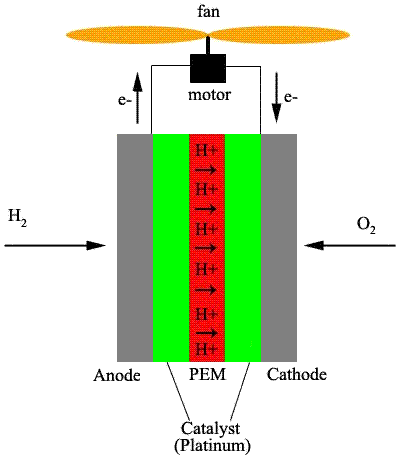 |
A: Refering to the diagram, the hydrogen molecules are separated into hydrogen protons and electrons at the anode with the help of the platinum catalyst. The proton exchange membrane (a polymer electrolyte membrane) allows only the hydrogen protons to pass through to the oxygen side. The electrons, unable to go through the membrane, has to go through the electrical circuit to the oxygen side so that the process of forming water with the hydrogen protons and oxygen molecules can be completed. Electrical energy is produced as a result of the movement of electrons through the electrical circuit. The chemical reactions are as follows:
At the Anode: 2H2 -> 4H+ + 4e-
At the Cathode: O2 + 4e- + 4H+ -> 2H2O |
- Q: Is hydrogen dangerous?
A: Hydrogen, as a fuel, is no more dangerous and in some aspects is less dangerous than other commonly used fuels such as Methane and Propane. To prevent potential hazard arising from detonation of hydrogen due to concentration of the gas, care must be taken to prevent build up of hydrogen in confined spaces. This is easily achieved due to the high bouyancy and high average molecular velocity of hydrogen, making it the most rapidly dispersing of all gases. When hydrogen escapes, it rapidly disperses upwards. A safety concern with hydrogen is that it burns with a virtually invisible flame. However, fire fighters have the necessary equipment to detect such fires.
- Q: How is hydrogen produced?
A: Hydrogen can be produced by the following methods:
- Steam methane reforming - this is a process that converts hydrocarbon fuels, such as natural gas, into hydrogen and carbon monoxide. It is the most commonly used method and can produce hydrogen in large quantities.
- Electrolysis - this method uses electrical energy to split water into hydrogen and oxygen. The electricity used for this process can be generated from renewable sources, such as solar cells.
- Gasification - this method uses heat to break down biomass or coal into a gas from which hydrogen can be generated.
- Photobiological techniques - this method uses algae to produce hydrogen in the presence of sunlight.
- Photoelectrochemical processes - this method uses sunlight (not energy from solar cells) to split water into hydrogen and oxygen.
- Thermochemical processes - this method uses nuclear or solar heat to split water into hydrogen and oxygen.
- Q: How is hydrogen stored (as hydrogen)?
A: Hydrogen gas can be stored in the following ways:
- As compressed hydrogen in pressurised cylinders - this method is very commonly used for small amounts of the gas.
- As liquid hydrogen - at -251°C, this is currently the most widely used method of storing large quantities of hydrogen.
- In a metal absorber as a reversible metal hydride - some metals, particularly alloys of titanium, iron, manganese, nickel, chromium and others react with hydrogen to form a metal hydride in a very easily controlled reversible reaction. The hydride material, contained in a pressure vessel, absorbs hydrogen like a sponge. To release the hydrogen, small amount of heat, usually from the environment, is applied. When hydrogen is released, the vessel will cool slightly. The vessel can be warmed slightly to increase the rate of discharge.
- In carbon nanofibres - in this method, hydrogen is stored in carbon nanofibre structures. A lot of research has been carried out on this method of hydrogen storage and there is a wide range of reported hydrogen absorption values on the nanofibres. However, a consensus has yet been reached on the practicality of using these materials in real gas storage systems.
- Q: When everyone uses fuel cells instead of other forms of energy producing engines, will oxygen be used up (because fuel cells use oxygen from the air to form water)?
A: The efficiency of fuel cells is much better than other types of energy producing engines. This means that the use of oxygen will be less than that used by other engines. Besides consuming oxygen, other engines produce many harmful gases (both to humans as well as the environment). Nature takes care of the production of oxygen (for example, by plants). If oxygen can be deplicted by the use of fuel cells, then it would have long been deplicted by the use of other engines.
|